Bringing the Margins to the Center.
HOURS
noon-6pm Tue-Sat
2467 Hilyard St, Eugene, OR
Bringing the Margins to the Center
!
Bringing the Margins to the Center !
Message us to buy online and pick up in the store, or if you are farther afield and can’t make it in, we will mail it to you.
(NOTE: We’ve only digitized 50% of current stock so ask using our contact form if you don’t see something online!)
-
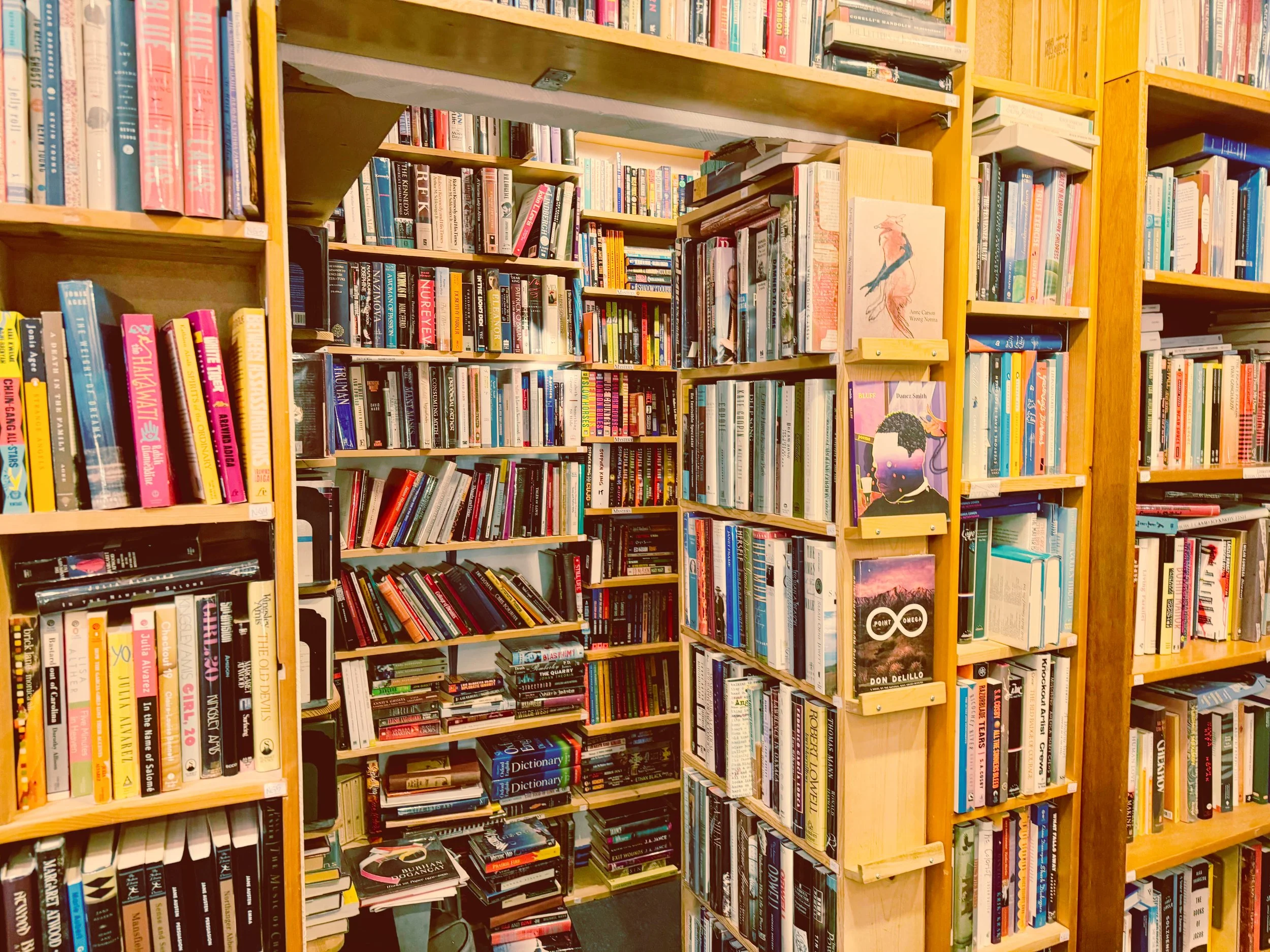
Outliers Books is a queer-owned and operated third space located in Eugene, Oregon. We are a place of care and community devoted to books that bring delight and build movements and the communities that sustain them. Queer. Trans. Black. Indigenous. Brown. Disabled. And those at the intersections of those voices can be found with Outliers Books.
-
Movements are built with incisive analysis AND joy; thoughtful examination AND shelter from the storm; and perhaps most importantly, change depends on the world building that underpins exceptional storytelling.
-
This is Kel. I shepherd Outliers Books. It’s 900 square feet. It is 12 blocks from my house.
On paper, it is a standard small business narrative. Inventory, rent, utilities, loan repayment, point of sale systems, five days a week with the lights on. The math is real. The margins are thin. The work will be constant.
But that is not the real story.
The real story is that I bought a bookstore because we are living in a moment when public space is shrinking, when language is being weaponized, when entire communities are being violently forced to disappear.
I bought a bookstore as a physical argument for the existence of radical voices in third spaces.
I bought a bookstore because fascism thrives in isolation, and books thrive in conversation.
Admittedly, I am deeply enamored with the very idea of a third space. I often encourage my clients to find them to do their writing. Neither home nor work. A space for shaking loose the confines of the expected.
It is the coffee shop where you overhear someone else’s conversation and it changes you. It is the community center where you attend a meeting and realize you are not alone. It is the bookstore where you sit on the floor, unhurried, and read the first line of a book that names something you have felt but never articulated.
Authoritarian movements understand the power of these spaces. That is why they target them. They attack libraries. They defund public institutions. They label certain gatherings domestic terrorism.
They want us separated from one another and separated from language.
A bookstore devoted to marginalized voices is a refusal of that project.
I have spent my life in rooms where words matter.
As a journalist, I was trained to ask better questions. To sit across from someone and listen long enough for the real story to emerge. Journalism taught me that democracy depends on informed people who can access information and weigh it for themselves. It also taught me that stories shape reality. What we amplify matters. And in the face of the current propaganda labeled “news,” I believe that the “we” is each of us and we have to do the amplifying.
As a journalism professor, I watched students learn that their voices had consequence. I saw them grapple with the ethics and the discomfort of telling stories that were not their own. I taught them that a free press is not an abstraction. It is a daily practice. It requires courage. And, above all, it is fragile. If I were teaching now, I would tell them that it is dying. I would tell them to use every tool they have to speak truth to power with the same determination they had planned to take to complicit MSM newspapers.
As a community organizer, I learned that change does not happen because one person thinks it should. It happens because people gather. Because they meet in living rooms and in basements and on street corners. Because they knock on doors. Because they create spaces where others feel safe enough to speak. It is exhausting. It takes all of us.
As a productivity coach with The Professor Is In, I have the profound privilege of spending every day talking with brilliant humans. Scholars who have devoted their lives to thinking deeply about power, identity, culture, climate, policy and all the ways it intersects across the disciplines.
I talk with them as they wrestle with institutions that do not value them. I help them clarify their arguments, situate their work and find their intellectual worth beyond the narrow constraints of tenure files and impact factors.
In every iteration of my work, the through line has been the same: Words matter. Community matters. Structures matter.
A bookstore is all three.
It is an economic structure that says stories have value.
It is a community structure that says you can come in here and be among others.
It is a linguistic structure that says these voices belong on shelves and ultimately in your hands.
Let me be clear, buying a bookstore in this moment is not nostalgia. It is not a boomer longing for paper and dust jackets.
It is a strategic choice.
It is an investment in a physical site where marginalized authors are centered, not tokenized. Where events are not promotions but anchors. Where reading groups, author talks, and quiet browsing coexist. It is also, frankly, an act of hope.
Reading Mariame Kaba taught me that hope is not a feeling. It is a discipline. “It’s less about ‘how you feel,’ and more about the practice of making a decision every day, that you’re still gonna put one foot in front of the other, that you’re still going to get up in the morning.”
Exercising hope will happen in arranging and rearranging shelves and sending in rent checks. It will be opening the door five days a week even when the news is brutal. It will be curating displays of the voices of outliers and trusting that people will pick them up and buy them. It will be hosting a conversation that might make someone braver.
Fascism depends on narrowing imagination. It insists there is only one way to belong, speak and think. It demands that we simply stop accepting the existence of a prism.
A bookstore explodes that premise. It is multiplicity embodied. It is shelves of contradiction and complexity. It is proof that human experience cannot be reduced to a single narrative.
I am not naïve about the risks. Independent bookstores operate on tight margins. There will be months when the numbers are uncomfortable. There will be days when I will wonder what possessed me. But I have watched academics navigate careers through devastating transformations. I have watched journalists keep reporting under threat. I have watched organizers show up again and again after losses.
Hope may be the discipline but courage is the cumulative result.
So is community.
This bookstore will be small. It will not single-handedly stop authoritarianism. But it will offer room to imagine its end. It will offer books that tell the truth. It will offer a place to gather, to argue and to imagine the world we all deserve to live in.
And for me, it will be a continuation, not a departure. From the newsroom to the classroom to the organizing meeting to the coaching call, I have always believed that informed, connected people are harder to silence.
So I bought a bookstore.
Because stories are infrastructure.
Because community is resistance.
Because fascism fears rooms full of people who are reading.
Because … third space.
Stay tuned. I promise to take you on the journey. And oooooooh the books I will share. (Did I mention buying a bookstore really means buying an inventory of 30,000 books that need to be catalogued and sold!?)
PS: For my coaching clients and others who might want to work with me: Never fear I’m not going anywhere. We just might be chatting among the books. Follow the adventure on Instagram
Check out the Outliers Books Instagram for book recommendations, updates about the store, and upcoming events!